
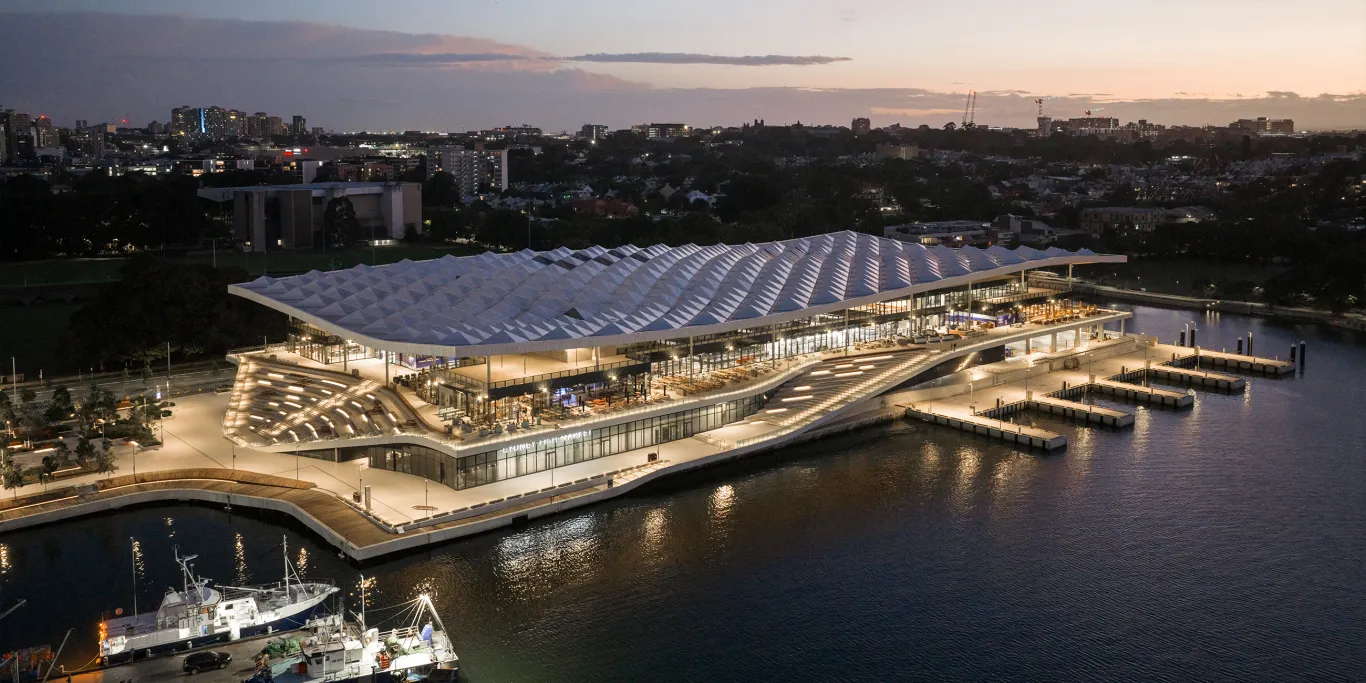
The new Sydney Fish Market in Blackwattle Bay is a high-design architectural triumph, but the best part remains the guy in gumboots hose-downing the deck at five in the morning.
Sydney has a long history of turning basic civic functions into architectural statements. We took a ferry terminal and turned it into Circular Quay, built an opera house on a tram depot site, and now, after six years and more than $750 million, we have given the city’s fishmongers a sweeping, wave-roofed cathedral on the water.
When Danish architecture firm 3XN, alongside local partners BVN, designed the new Sydney Fish Market in Blackwattle Bay, they could have easily built a gleaming, sterile shopping mall that happened to sell snapper. Instead, they did something far cleverer: they built a 2,500-tonne floating timber roof over the whole thing, encased the auction floor in floor-to-ceiling glass, and left the raw, wet, chaotic spectacle of wholesale fish trading right at the center of the room.
Walk onto the upper promenade at 6:00 AM, and you can look down through the glass into the auction hall. Below, 160 buyers sit in a Dutch-style clock auction, bidding on dozens of tonnes of tuna, kingfish, and rock lobster while forklift drivers weave around stacks of crushed ice. Upstairs, people are sitting down to flat whites, oysters on the half-shell, and fresh sashimi.
Most cities keep their heavy food logistics buried in industrial estates past the airport, behind razor wire and loading docks. Sydney decided to put fifty tonnes of daily seafood catch under a timber canopy on the edge of the CBD and invite six million people a year to watch the ice melt.
The genius of a good market is that it shouldn't feel too polished. If you make it too neat, it stops feeling like a market and starts feeling like a food court. What makes the new Blackwattle Bay site work is that despite the glulam timber beams, custom plaster render made from ground oyster shells, and amphitheatre seating, the core rhythm hasn't changed. It still smells like salt water and kelp. The fishmongers still yell over the counter. You still have to watch your ankles around the ice crates.
It is easy to be cynical about megaprojects that take years, cost hundreds of millions, and promise to "redefine the waterfront." But standing on the new foreshore promenade with a tub of fried calamari while a trawler unloads its hull fifty metres away, you realize the city got this one right. They built a magnificent room, but they remembered to let the fish in.
Share
Copy link