
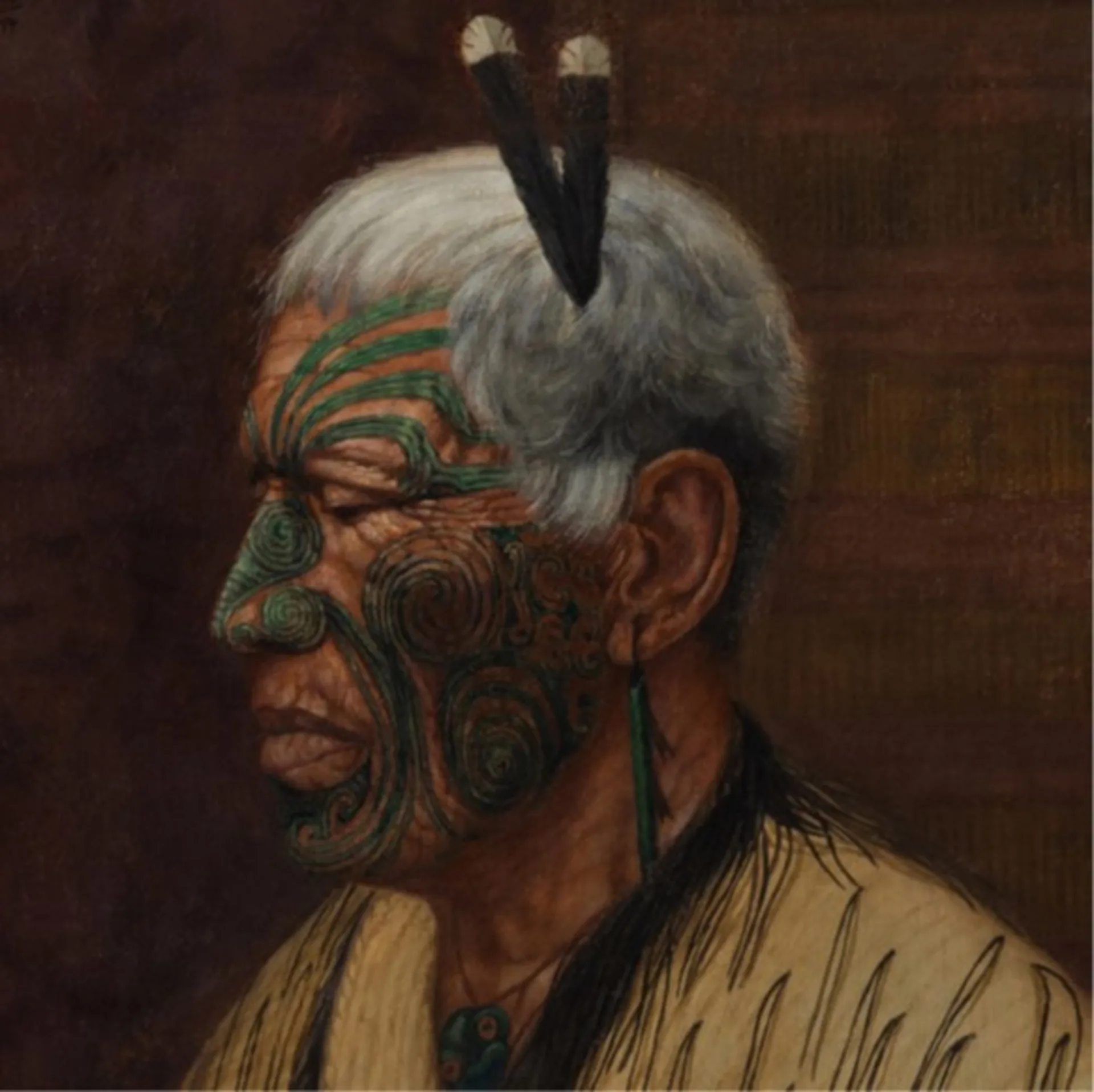
A portrait missing from public view for more than a century has reappeared with a $420,000 price tag and a very awkward question attached: is it actually a Goldie?
At the beginning of the week, the story was almost too good. A portrait believed to have been painted by C. F. Goldie in 1917 had resurfaced after more than a century, complete with old exhibition labels, a newly identified sitter and a vendor who had taken a gamble on it at a Melbourne estate sale. By the end of the week, six art experts and auctioneers had told RNZ they did not believe Goldie painted it at all.
The painting is called Lost in Thought, Ngāheke, An Arawa Chieftain, and NZ artbroker has presented it as a rediscovered Goldie worth around $420,000. The gallery says five years of research connected the work to the Canterbury Society of Arts’ 1917 exhibition and identified the sitter as Patara Te Ngūngūkai, a high-ranking chieftain and tohunga of Tūhourangi Ngāheke. Labels on the frame, an exhibition number and comparisons with archival photographs were all offered as parts of the case.
It is exactly the sort of discovery the art market loves because it arrives with everything already built in: a famous name, a lost object, a century-long gap and a stranger who bought something uncertain from an estate and may now be sitting on several hundred thousand dollars. You can almost see the documentary version taking shape before anyone has looked too closely at the brushwork.
Then people looked more closely at the brushwork.
Cordy’s Auctioneers director Andrew Grigg said the painting had previously passed through his hands and that he declined to sell it because he was not convinced by the workmanship. Former Auckland Art Gallery principal conservator Sarah Hillary inspected it under infrared and ultraviolet light in 2021 and said the surface appeared flatter than she would expect from Goldie, particularly around the skin and mataora. Artist Phillip Waddington, who has studied Goldie’s work for decades, was more direct, describing it as the work of a novice painter. Dunbar Sloane said his auction house had also pulled an earlier listing after examining the work in person. The full dispute is laid out in RNZ’s reporting through 1News.
NZ artbroker has stood behind the research while acknowledging that further forensic testing could be undertaken. Director Jen McBride said some of the earlier assessments were made before the exhibition history and possible identity of the sitter had been established, and argued that the additional context had strengthened the vendor’s case. The gallery has also said it would support more investigation given the public disagreement.
This is where the story becomes much more interesting than a simple fake-or-real reveal. Paintings do not arrive at $420,000 because someone looks at them and feels a strong personal connection. They arrive there through a chain of confidence involving provenance, documentation, expert opinion, physical examination, market reputation and, eventually, a buyer prepared to believe the chain holds.
A catalogue number can change the mood. So can an old label, a familiar pose or a photograph that appears to match the sitter. None of those things is meaningless, but neither do they automatically turn the paint itself into Goldie’s paint. The argument now seems to sit between two different kinds of evidence: the historical trail attached to the object and the specialists looking closely at how the object was made.
Goldie’s technique makes that distinction particularly important. His portraits are known for meticulous surface detail, carefully built layers and highly observed skin, hair and tā moko. Te Papa describes a process involving detailed drawing, restrained pigments and increasingly fine brushstrokes, while Te Ara notes the technical precision for which his work became famous. When experts say the painting feels flat or the brushwork does not behave like Goldie’s, they are not simply saying they dislike it. They are questioning whether the hand matches the name on the work.
There is another story sitting underneath the market dispute too. The portrait depicts a Māori ancestor whose identity and whakapapa matter beyond whether the signature adds several zeroes to the price. Waatea News has noted that the painting’s reappearance has prompted discussion about Tūhourangi heritage and the stewardship of Māori cultural material, which makes the argument about ownership and authenticity larger than one vendor’s return on an estate-sale gamble. A painting can be culturally significant even while experts disagree about who painted it.
The painting is due to be shown publicly in Christchurch on July 23. The object itself will look exactly as it did before the disagreement broke into public view, but almost nobody will be looking at it in quite the same way.
Share
Copy link